Describe the neighborhood.
Describe the kitchen. See Italian Days p 23.
When on a street, give the Italian name and then the English. For example:
On our street—Via Spadari ("street of the swordmakers")—is a shop ...
We will see more of Roma in a few weeks—first, we have to get to Bari, and for that we are on the train. The four-hour train from Roma to Bari presented us with views of an
increasingly flat and arid countryside. Orchards of olives, rows of oranges, and fields of vegetables brought to mind California's central valley. If we had not enjoyed the scenery featured in Lolita Lobosco, a Bari-based tv show, I might have come to fear we were headed for disappointment. But not to worry, Bari won't disappoint.
Update:
Bari is discovered by the NY Times.
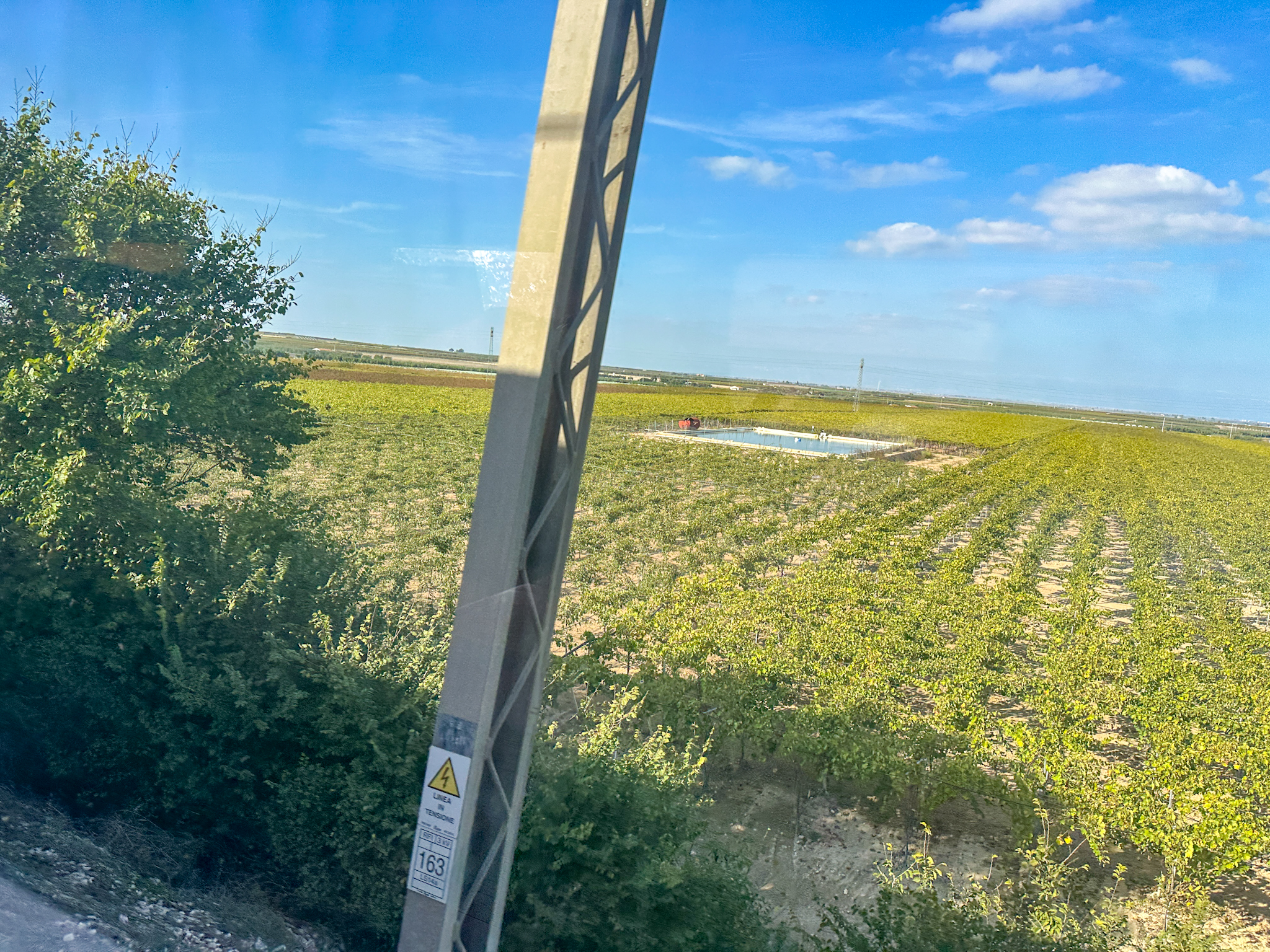
View from train
Our apartment is an easy find. Exit the train station, head straight down the main shopping street, it is carless of course, then when the grid of streets is replaced by the tangle of the old city you are there.
The old town of Bari is a dense and confusing warren of narrow passages, charming old buildings, and striking old churches. It is said the streets were laid out to discourage both invaders and strong winds coming off the sea, which might be true. They certainly discouraged me when we were trying to find our way home from a restaurant. My frustration reminded me of our first visit to Venice, a champion of confusing city layouts.
I never did get completely comfortable with Bari's streets.
The photo is of me at our apartment door. The street, Corte San Triggiano, is typical of old town Bari, dense with greenery, doorways, hanging laundry, and barely wide enough for a scooter to quickly zip past, which is of course what they do.
There is not a lot of privacy in the old town, especially in the street level units such as the one we rented. People walking by, just a foot or two from your door or window, can look in and see you.