While in Antwerp we visited the Red Star Line museum. The Red Star Line was a shipping company founded in 1871. It was a joint venture between the Société Anonyme de Navigation Belge-Américaine of Antwerp and the International Navigation Company of Philadelphia. Ports of call included Antwerp, Liverpool, Southampton, NYC and Philadelphia.
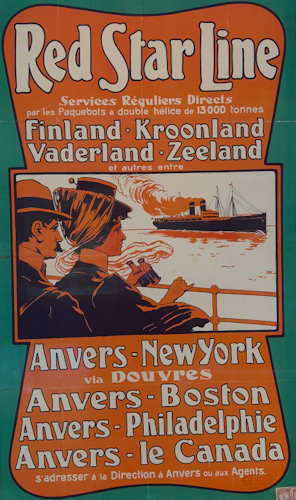
Red Star transported cargo from America to Europe on the outbound voyage and passengers on the return voyage. The company flourished until the First World War. During the line's heyday two ships left for North America every week.
But in the 1920s, when the United States imposed immigration restrictions, the shipping line began to experience financial problems. It was liquidated in 1934 and a German ship-owner, Arnold Bernstein bought the ships. Then the Holland-America Line took over the fleet in 1939 when Bernstein was forced to flee Germany.
In 2013 the former warehouses of the company were re-purposed as a museum with a focus on travel stories that could be retrieved through relatives of the some two million of the former Red Star Line passengers. Some of the passengers are still well known, such as Albert Einstein and Irving Berlin.
The museum exhibits tell the tales experienced by real immigrants, and these tales reflect the political and economic environment of immigration. The stories sound familiar to what we observe today. The triggers for immigration have not changed, such as poverty, ambition, racism, political upheaval, and family re-unification. And the messages from political leaders sound as if pulled from today's paper, in fact the exhibits quote a certain current leader who uses racism and scapegoating as part of his political schtick. I'd say we seem to be stuck in a loop.
It is a wonderful museum, an unexpected treasure. It jarred awake memories of stories told of my mother and her parents, who were émigrés from political upheaval. It also reminded me of the ferry from Tarifa to Tangier when the ship stopped to assist refugees who were risking their lives to reach a better life in Europe.


In January 1923, during one of his patrols, American border guard John Coe spied on the frozen Detroit River through his binoculars, and he saw four people on the white ice coming his way who looked like ghosts. They were two Belgians and an Italian, accompanied by a Canadian smuggler. They had draped white sheets over themselves as camouflage and covered the soles of their shoes with iron to prevent slipping. It was a common practice. The local population spoke of 'ghost walkers', as a symbol of a growing illegal industry in the American-Canadian border area of the early 1920s.
These migrants, draped in white sheets, silently and carefully moving across the ice, desperate, determined and vulnerable were the starting point for this exhibition in which visual artist MASHID MOHADJERIN reinterprets a forgotten chapter in history.
In the early 1920s, Europe was in ruins. For many, America remained the land of new opportunities. Despite strict immigration quotas in the US, many Belgians embarked on the RED STAR LINE for Canada. Smugglers helped them reach America, on journeys that were often fraught with danger and exploitation.
Little has been preserved about this group of compatriots: a few newspaper articles, police reports, and photographs. American newspapers reported on DRIFTING BELGIANS', who lived in constant fear of arrest and deportation. The parallels with current American headlines on migration are striking.
In January 1923, during one of his patrols, American border guard John Coe spied on the frozen Detroit River through his binoculars, and he saw four people on the white ice coming his way who looked like ghosts. They were two Belgians and an Italian, accompanied by a Canadian smuggler. They had draped white sheets over themselves as camouflage and covered the soles of their shoes with iron to prevent slipping. It was a common practice. The local population spoke of 'ghost walkers', as a symbol of a growing illegal industry in the American-Canadian border area of the early 1920s.
These migrants, draped in white sheets, silently and carefully moving across the ice, desperate, determined and vulnerable were the starting point for this exhibition in which visual artist MASHID MOHADJERIN reinterprets a forgotten chapter in history.
In the early 1920s, Europe was in ruins. For many, America remained the land of new opportunities. Despite strict immigration quotas in the US, many Belgians embarked on the RED STAR LINE for Canada. Smugglers helped them reach America, on journeys that were often fraught with danger and exploitation.
Little has been preserved about this group of compatriots: a few newspaper articles, police reports, and photographs. American newspapers reported on DRIFTING BELGIANS', who lived in constant fear of arrest and deportation. The parallels with current American headlines on migration are striking.
In January 1923, during one of his patrols, American border guard John Coe spied on the frozen Detroit River through his binoculars, and he saw four people on the white ice coming his way who looked like ghosts. They were two Belgians and an Italian, accompanied by a Canadian smuggler. They had draped white sheets over themselves as camouflage and covered the soles of their shoes with iron to prevent slipping. It was a common practice. The local population spoke of 'ghost walkers', as a symbol of a growing illegal industry in the American-Canadian border area of the early 1920s.
These migrants, draped in white sheets, silently and carefully moving across the ice, desperate, determined and vulnerable were the starting point for this exhibition in which visual artist MASHID MOHADJERIN reinterprets a forgotten chapter in history.
In the early 1920s, Europe was in ruins. For many, America remained the land of new opportunities. Despite strict immigration quotas in the US, many Belgians embarked on the RED STAR LINE for Canada. Smugglers helped them reach America, on journeys that were often fraught with danger and exploitation.
Little has been preserved about this group of compatriots: a few newspaper articles, police reports, and photographs. American newspapers reported on DRIFTING BELGIANS', who lived in constant fear of arrest and deportation. The parallels with current American headlines on migration are striking.

For this exhibition, Mohadjerin retraced the journey of European emigrants. She travelled to Halifax, trekked through the vast Canadian landscapes and ventured across the border to Detroit, where she met the descendants of Belgian migrants.
Through photography, sound, and a video installation, Mashid Mohadjerin visualises the journey of these 'DRIFTING BELGIANS'. In addition, historical postcards, letters, and WhatsApp messages form collages that evoke a glimpse into the timeless aspects of migration: the search for happiness at the risk of one's own life, how dreams sometimes clash with reality, and which parts of the story reach home.
For this exhibition, Mohadjerin retraced the journey of European emigrants. She travelled to Halifax, trekked through the vast Canadian landscapes and ventured across the border to Detroit, where she met the descendants of Belgian migrants.
Through photography, sound, and a video installation, Mashid Mohadjerin visualises the journey of these 'DRIFTING BELGIANS'. In addition, historical postcards, letters, and WhatsApp messages form collages that evoke a glimpse into the timeless aspects of migration: the search for happiness at the risk of one's own life, how dreams sometimes clash with reality, and which parts of the story reach home.
For this exhibition, Mohadjerin retraced the journey of European emigrants. She travelled to Halifax, trekked through the vast Canadian landscapes and ventured across the border to Detroit, where she met the descendants of Belgian migrants.
Through photography, sound, and a video installation, Mashid Mohadjerin visualises the journey of these 'DRIFTING BELGIANS'. In addition, historical postcards, letters, and WhatsApp messages form collages that evoke a glimpse into the timeless aspects of migration: the search for happiness at the risk of one's own life, how dreams sometimes clash with reality, and which parts of the story reach home.


One of my favorite parts of the exhibition is a video called Dance by Hans Op de Beeck. In a short (9-minute) performance de Beeck gives us a dramatic taste of the experience of immigration. It is quite moving.
Note that the video takes a bit of bandwidth, almost too much for my connection here in Antwerp. If the video stops, be patient, tap the screen a couple times, then wait. Admittedly, it helps if you have just been through the museum and seen what immigrants experience, the good byes, interviews, crowding, and the long disinfecting showers.
One of my favorite parts of the exhibition is a video called Dance by Hans Op de Beeck. In a short (9-minute) performance de Beeck gives us a dramatic taste of the experience of immigration. It is quite moving.
Note that the video takes a bit of bandwidth, almost too much for my connection here in Antwerp. If the video stops, be patient, tap the screen a couple times, then wait. Admittedly, it helps if you have just been through the museum and seen what immigrants experience, the good byes, interviews, crowding, and the long disinfecting showers.
One of my favorite parts of the exhibition is a video called Dance by Hans Op de Beeck. In a short (9-minute) performance de Beeck gives us a dramatic taste of the experience of immigration. It is quite moving.
Note that the video takes a bit of bandwidth, almost too much for my connection here in Antwerp. If the video stops, be patient, tap the screen a couple times, then wait. Admittedly, it helps if you have just been through the museum and seen what immigrants experience, the good byes, interviews, crowding, and the long disinfecting showers.


Hans Op de Beeck
'Dance'
Music: Johan Hoogewijs
For this video artwork from 2013, Hans Op de Beeck drew inspiration from the actions that emigrants underwent in the buildings of the Red Star Line.
800 extras participated in the filming, shot by a crew of 30 employees in a single day in the warehouses of Park Spoor Noord. For the collective naked shower scene under 144 showerheads, members of the Deurne Polar Bear Club and naturist associations were contacted.
The title refers to migration as an irregular rhythmic movement, a balancing act on the arduous journey between the old identity of home and the reality of the new world, a journey that changes everyone.
The shower scene underscores the powerlessness of migrants. "Bank director or poor farm laborer, when we shed our second skin, everyone is equal," states the artist. Furthermore, everyone wears similar clothes, drags the same gray suitcase, and makes the same movements. This collectivity amplifies the banality of every action and suggests that it is the individual story of every migrant.
Hans Op de Beeck
'Dance'
Music: Johan Hoogewijs
For this video artwork from 2013, Hans Op de Beeck drew inspiration from the actions that emigrants underwent in the buildings of the Red Star Line.
800 extras participated in the filming, shot by a crew of 30 employees in a single day in the warehouses of Park Spoor Noord. For the collective naked shower scene under 144 showerheads, members of the Deurne Polar Bear Club and naturist associations were contacted.
The title refers to migration as an irregular rhythmic movement, a balancing act on the arduous journey between the old identity of home and the reality of the new world, a journey that changes everyone.
The shower scene underscores the powerlessness of migrants. "Bank director or poor farm laborer, when we shed our second skin, everyone is equal," states the artist. Furthermore, everyone wears similar clothes, drags the same gray suitcase, and makes the same movements. This collectivity amplifies the banality of every action and suggests that it is the individual story of every migrant.
Hans Op de Beeck
'Dance'
Music: Johan Hoogewijs
For this video artwork from 2013, Hans Op de Beeck drew inspiration from the actions that emigrants underwent in the buildings of the Red Star Line.
800 extras participated in the filming, shot by a crew of 30 employees in a single day in the warehouses of Park Spoor Noord. For the collective naked shower scene under 144 showerheads, members of the Deurne Polar Bear Club and naturist associations were contacted.
The title refers to migration as an irregular rhythmic movement, a balancing act on the arduous journey between the old identity of home and the reality of the new world, a journey that changes everyone.
The shower scene underscores the powerlessness of migrants. "Bank director or poor farm laborer, when we shed our second skin, everyone is equal," states the artist. Furthermore, everyone wears similar clothes, drags the same gray suitcase, and makes the same movements. This collectivity amplifies the banality of every action and suggests that it is the individual story of every migrant.